New Arrivals This Week 8/6/13 to 8/12/13

by Becky "Infinite Golf Tees" Topol

Mars Needs Mechanics is the premiere game from local game designer Ben Rosset.  This economy-based game takes place at a thrilling time for the British Empire: Her Majesty the Queen demands the construction of a colony on Mars!  Players are Aether Mechanics competing for a position on the crew, and must use careful timing and economic manipulation to get the most valuable groupings of resources and devices at the right times, aiming to gain cogs as currency.  Whoever has the most cogs at the end of the game has won their place aboard the steampunk space vessel H.M.S. Victoria VII!  This is one of several economy-driven steampunk-themed games to come out recently, and I’m honestly really excited to see such a cool aesthetic making a break into boardgaming.  Other games in this family include Kings of Air and Steam, and Planet Steam, which is packed full of intricate plastic pieces and just arrived from Fantasy Flight.

The tactical board game Rialto drops you into the network of bridges and canals that make up Venice.  A card-driven worker-placement game, Rialto lets you take charge of the city by placing your own councilmen into Venice’s districts, constructing essential bridges and buildings, and by placing gondolas in the canals.  All of these actions improve your standing in the city and advance you along the Victory Point track.  Whoever has taken the position of Doge gets special bonuses, so be sure not to let them sit comfortably for too long!

Pixel Lincoln is an 8-bit-styled adventure deckbuilding game, where you must assemble an awesome deck of items and weapons to help our hero Pixel Lincoln restore the balance of time and space.  Lincoln must defeat such heinous enemies as the Laser Shark, Totally T-Rex, and of course John Wilkes Booth, so be sure to equip him with kickin’ weapons like a swordfish or his Beardarang.  Meant to feel like a classic video game, the completely non-electronic Pixel Lincoln allows you to explore ever-changing and highly customizable levels that are discovered as you play, and like all good video games it allows you to play on your own or with friends.  Are you ready to beat the high score?

For puzzlers of all kinds, really amazing - and slightly insane - things have arrived in the store. Double Sided Impossipuzzles are the stuff of nightmares for some, and sweet dreams for others. These puzzles feature two images, one on the front of the pieces and one on the back.  Both pictures are repeating patterns, and often in the same color palette.  From candies to golf to penguins, there’s a pattern to please any puzzle fanatic, and they’re available in standard and mini sizes.  If you like jigsaws as well as other types of puzzles, the Sudo-Kube and Word-Kube are definitely worth your attention.  Each one is a jigsaw that when solved, forms the image of a sudoku or crossword puzzle as well as all the clues needed to solve it.  You can then solve the puzzles with the included dry-erase pen.  This is a super cool option for someone who likes different types of puzzles and is looking for a great new challenge.

We’re excited to announce that we just got a huge delivery of Liberty Puzzles!  These high-quality laser-cut wooden jigsaws feature stunning art, and “whimsy pieces” that are cut into shapes that match the theme of the puzzle image.  Some of the arrivals are the classic images you’ve seen on our shelves before, and some are all-new designs that promise to make for challenging and gorgeous puzzling.  We even got some more of the Little Liberty puzzles, which are smaller and perfect for children aged 5 and up.

On top of all that, Betrayal at House on the Hill is back in stock! This creepy horror-movie-in-a-box saw a boost in popularity in our store right before it went out of print, to the frustration of all.  If you were among those players who tried it out at game nights here but didn’t get a chance to pick it up, now’s your chance to snag your own copy.  We also just got Sherlock, one of our very favorite kids' games, back in the store.  This simple deductive reasoning game for the younger set is a consistent hit in our afterschool games classes, but has been unavailable for some time.  If your little sleuth has been trying to hunt down a copy, look no further!
New Arrivals This Week 7/23/2013 to 7/29/2013

by Becky "President of Everyone" Topol

There is so much great new stuff in the store this week!  After a torturous wait, we’re thrilled to have
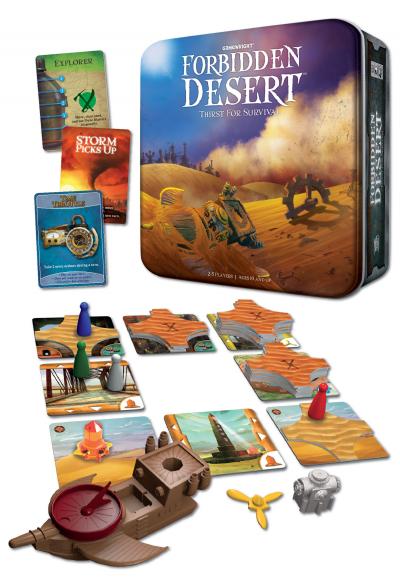
Forbidden Desert on the shelves.  A thematic sequel to the massively popular Forbidden Island, Forbidden Desert sets you out on a cooperative quest to find the parts of a legendary flying machine, scattered in the shifting sands of a desert.  Forbidden Desert features an ever-changing board, constantly re-shaped by an increasingly brutal sandstorm.  You and your team must carefully manage your cards to get to various places in the desert, hoping to locate the machine parts along the way.  If you can rebuild the ship, you fly out of the desert as heroes.  If not, you become permanent parts of the desert yourselves.  The flying machine included in the game is EXTREMELY cool, with various detailed and moving parts.  A bit harder than its predecessor, Forbidden Desert is an awesome choice for adventure-seekers of all ages.

We have several games in the store that we like to call the “DC games”.  These are board games that focus on politics, legislation, corporate sneakiness, and usually plenty of backstabbing.  Added to this pantheon is Corporate America, a satirical game about corporate influence in government.  Each player takes the helm of a corporation, and throughout the various game phases they attempt to build up their company, make money, bribe each other, manipulate the consumer population, and eventually run for President.  The President gets Executive Privilege, can affect other companies, and of course, blatantly break their campaign promises.  All players keep their money secret throughout the game, and whoever has the most money at the end wins.  Are you underhanded enough to rule Corporate America?

Suburbia is a tile-laying game in which players try to build their small town up to a major metropolis.  The first aim is to make your town self-sufficient by building commercial, industrial, civic, and residential areas, as well as special points of interest that make use of the resources of nearby towns.  As your town grows and improves, more people will flock to live there, and the town will produce more money and resources.  Cities can grow to contain massive skyscrapers and bustling international airports, attracting yet more citizens and cash.  Whoever has the biggest population at the end is the winner, with the greatest city of them all!  Suburbia snagged this year's Mensa Select award, so it's a great choice for those looking for a challenging twist on the popular civilization-building framework.

The streets of Victorian London are filled with fog and mystery, and it’s up to you to solve the case!  In Sherlock Holmes: Consulting Detective, you and up to seven of your friends all try to become top sleuth of London, aiming to beat out Sherlock Holmes himself!  The game, winner of the 1985 Spiel des Jahres Award, is chock-full of detailed parts and props including a London directory, detailed maps, newsprint, and a casebook.  Choose one of the ten included mysteries, and try to solve it faster and more efficiently than Master Holmes and your opponents.  More points are awarded when you use fewer clues to come to the right conclusion, so you must think carefully before you act.  The world of the game is deeply researched, and accurate with respect to the reality of Victorian London and the works of Arthur Conan Doyle.  Some players even choose to take the slow route to solve a crime, which costs points but allows them to follow every lead, explore the city, and meet characters like Lestrade, Moran, and Moriarty.  Full of opium dens, murdered lions, and missing paintings, Sherlock Holmes: Consulting Detective has a deep and engaging world well worth investigating.

And those are just a few of the cool new arrivals we’re excited about this week!  We also have an Edward Gorey themed dress-up game in the form of E. D. Ward: A Mercurial Bear, which is both adorable and slightly creepy.  The new Android: Netrunner expansion Creation and Control will be arriving today.  This deck focuses on Shaper and Haas Bioroid (which Kempe correctly predicted I wouldn't be able to spell right on the first try).  And for those of you who need a little more chaos in your lives, Fluxx: the Board Game will also be coming in today!  We have a demo I got a chance to peek at, and this thing looks wild.  Not only does it introduce a shifting, changing board to the Fluxx framework, but each player must now juggle several pawns, various goals, and crazy movement rules.  Be sure to check out our Looney Labs Game Night on August 6.  Andy Looney of Looney Labs will be here to demo Fluxx: the Board Game, as well as all your other Looney favorites.  Click here for more info!

Do you like the wild world of Fluxx: the Board Game or the manipulation and control of Corporate America?  Dig the adventure and danger of Forbidden Desert, the shadowed mystery of Holmes’ London, or the gleaming progress of Suburbia?  Let us know in a comment below!

The Mechanics of Catan

by David Kempe


My name is David Kempe, and I am a staff member at Labyrinth. Between all of us, the staff has played more than 90% of the games in the store. In an attempt to keep a knowledgeable staff, each of the employees here tends to specialize in a specific game area based on their tastes. A coworker recently said that I like my games like she likes her wine: “drier than the Sahara.” A game is “dry” if there is very little theme or if the theme of the game is much less important to the game play than the base mechanics. Lords of Waterdeep, Power Grid, Copycat, and Race for the Galaxy are some of my favorite games, and they are all quite “dry.” These games rely heavily on their mechanics.

 
People often compare a new game to one they’re more familiar with in order to better understand how it 
works, and a useful game to compare against is The Settlers of Catan.  This is because Catan is so widely-known, and also because it contains many gameplay elements which are frequently seen in other games.  Whenever I compare a game to Catan, I break down both games to their basic mechanics. At its core, Catan uses area control, negotiation/ trading, and resource management.


A game employs area control if there are different parts or sections of the board that players are trying to gain control over. More specifically, these games have areas that are in contention between the players. There may be areas that can be taken from other players, as in Risk or Discworld: Ankh-Morpork, where locations may change ownership many times during one game.  Areas may also belong to a player permanently once they’re claimed, as happens in Power Grid and The Settlers of Catan. These varying forms of area control highlight the main difference between Euro-style games and American games.  In Catan, a Euro game, the direction in which players expand is heavily influenced by where the other players choose to play.  Once a player chooses an area to settle, no player can move that settlement or take over that area. While players may expand strategically to stifle their opponents’ movement, there is no direct confrontation. In contrast, players directly attack each other in American games, like the classic Risk.   Area control as a mechanic made its debut through war games, which remain the most common place to find this style of play.


Resource management simply means a game has a limiting factor, usually money, which players need in order
to progress in the game. In Catan, players use wood, brick, wheat, sheep, and ore to buy cards as well as space on the board. Power Grid and Monopoly have money as their major limiting factor, but Power Grid also allows players to buy from a limited supply of coal and oil. In order for something to be considered a resource, players must work to get access to it.  Troops in Risk, for example, are not considered a resource; while they do limit players’ movement and options, players always get more troops at the beginning of their turn regardless of whether they are progressing well or not.

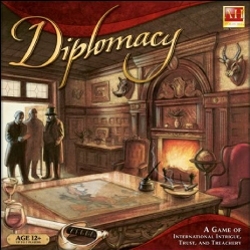
A game has a negotiation mechanic whenever there is interaction in a game where players can color opponents’ decisions by convincing them to act a certain way. In Catan, players must convince each other to trade resources, hoping to gain an advantage. In war games like Diplomacy, players can negotiate to influence or figure out who the other players will attack.  Negotiation can even occur in games where it does not factor as a core mechanic: A player could be convinced to buy a building in Puerto Rico or take a space in Lords of Waterdeep, but negotiation is not strictly required in these games.  Of these mechanics, negotiation is my favorite. Negotiation is what makes most games interactive and social. In fact, many games that don’t involve some kind of negotiation can be described as “multiplayer solitaire”. I am a huge fan of Race for the Galaxy, but it lacks the player interaction that I look for in most games.


The Settlers of Catan is an amazing game to attract new players to board gaming by introducing many of the core mechanisms common in Euro board games. I hope this rundown of the mechanics in Catan can be helpful to finding your next game.